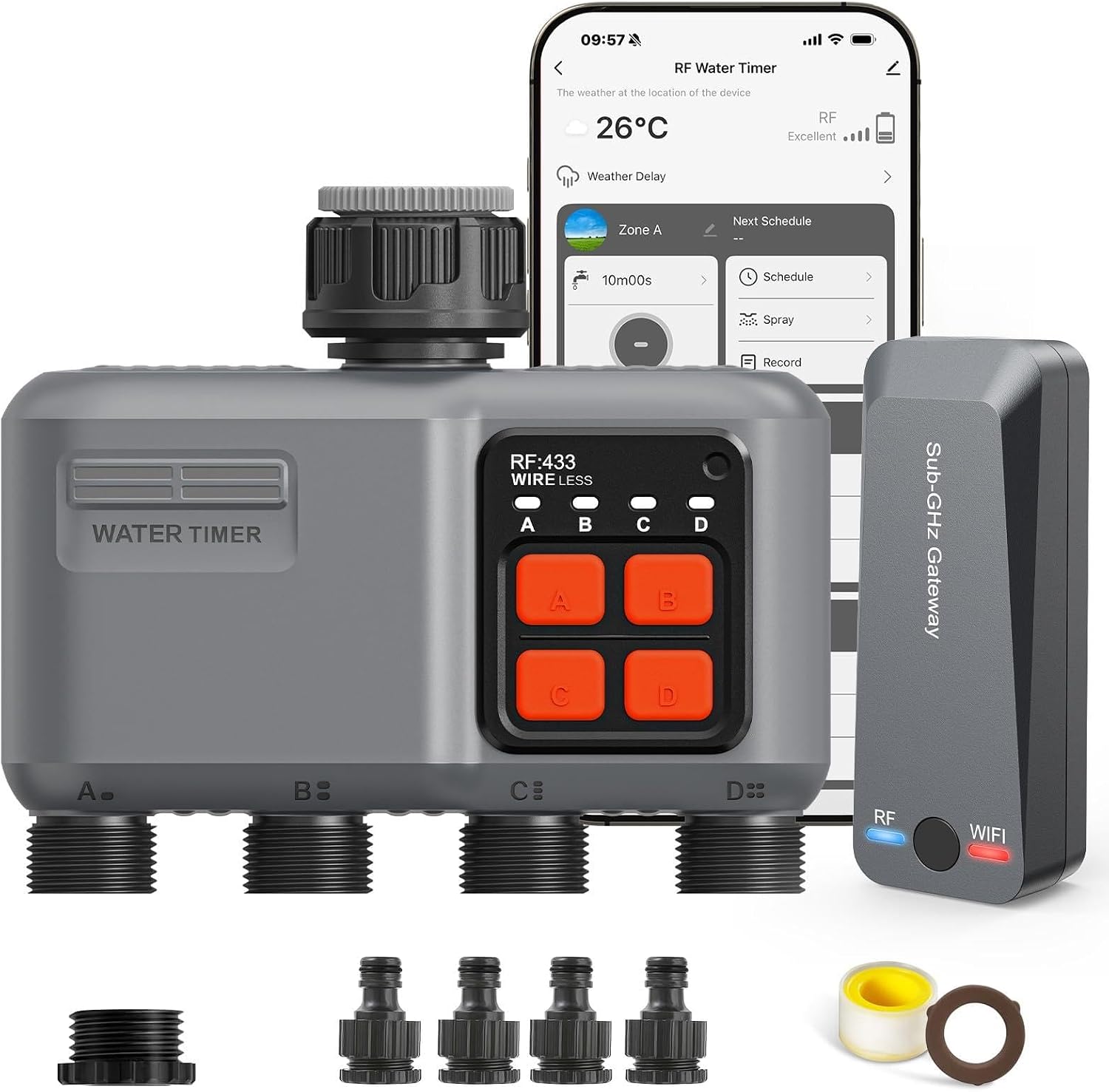
 Johgee
 4-zone UAE Dispatch
Johgee 4-Zone RF
Four zones, one app — radio control that reaches the far corner of the garden.
AED 399 VAT incl.
Wi-Fi vs RF · villa dead-zone fix
UAE villas are reinforced concrete — that is why garden Wi-Fi gadgets drop offline at the tap. An RF timer reaches your tap by radio instead. Here is the honest comparison, including when plain Wi-Fi is the better buy.
The physics, plainly
If you have searched Wi-Fi vs RF water timer, you have probably already watched a smart garden gadget "appear offline" the moment it is out by the tap. It is not a faulty unit — it is the walls. Most Dubai, Abu Dhabi and Sharjah villas are built from reinforced concrete and concrete block, and 2.4 GHz Wi-Fi loses strength fast through that material.
Your router usually sits deep inside the house. The garden tap is on the far side, past two or three walls. By the time the Wi-Fi reaches it, there often is not enough signal left to hold a connection — which is exactly why UAE villa Wi-Fi installers make a business out of fixing garden "dead zones".
A radio (RF) timer takes the walls out of the equation. An indoor gateway sits on your Wi-Fi in the strong-signal part of the house, then talks to the outdoor timer over a sub-GHz radio link. That lower frequency travels through concrete-block walls far better than 2.4 GHz Wi-Fi, so the timer at the tap stays reachable.
Honest note: Wi-Fi is perfectly fine sometimes
If your tap is on a balcony, in a courtyard, or in a small front garden within range of your router, you do not need RF. A straight 2.4 GHz Wi-Fi timer like the RainPoint is simpler and cheaper, and it will hold its connection. RF is the answer to distance and walls — not a tax everyone should pay.
Both are built for UAE heat and fit standard taps. The real fork is whether your signal has to cross walls to reach the tap.
How it works
Five steps from a dead-zone tap to a garden that waters on schedule — no plumber, no wiring.
Walk to the garden tap with your phone. If it drops to one bar or "no internet" there, a pure Wi-Fi timer will struggle in exactly that spot — the classic UAE villa garden dead zone.
Plug the Johgee indoor gateway into a Type G socket toward the middle of the house, joined to your 2.4 GHz network. It stays where the signal is good instead of fighting through walls.
Hand-tighten the outdoor timer onto your 3/4" BSP tap. No plumber and no tools — it screws on like a hose fitting.
The gateway links to the outdoor timer over a sub-GHz radio channel, which carries through concrete-block villa walls far better than 2.4 GHz Wi-Fi.
Set each zone to water before 8am in line with DEWA guidance, then pause, add a cycle after a dust storm, or check it — from home or from abroad.
Both fit standard UAE taps — the right pick comes down to how far your signal has to travel and how many zones you water.
Larger villa gardens with several zones and thick walls between the router and the tap.
Choose this if
Balconies, townhouses and smaller gardens where the Wi-Fi router is near the tap.
Choose this if
Still unsure? Compare both timers side by side .
Johgee Four zones, one app — radio control that reaches the far corner of the garden.
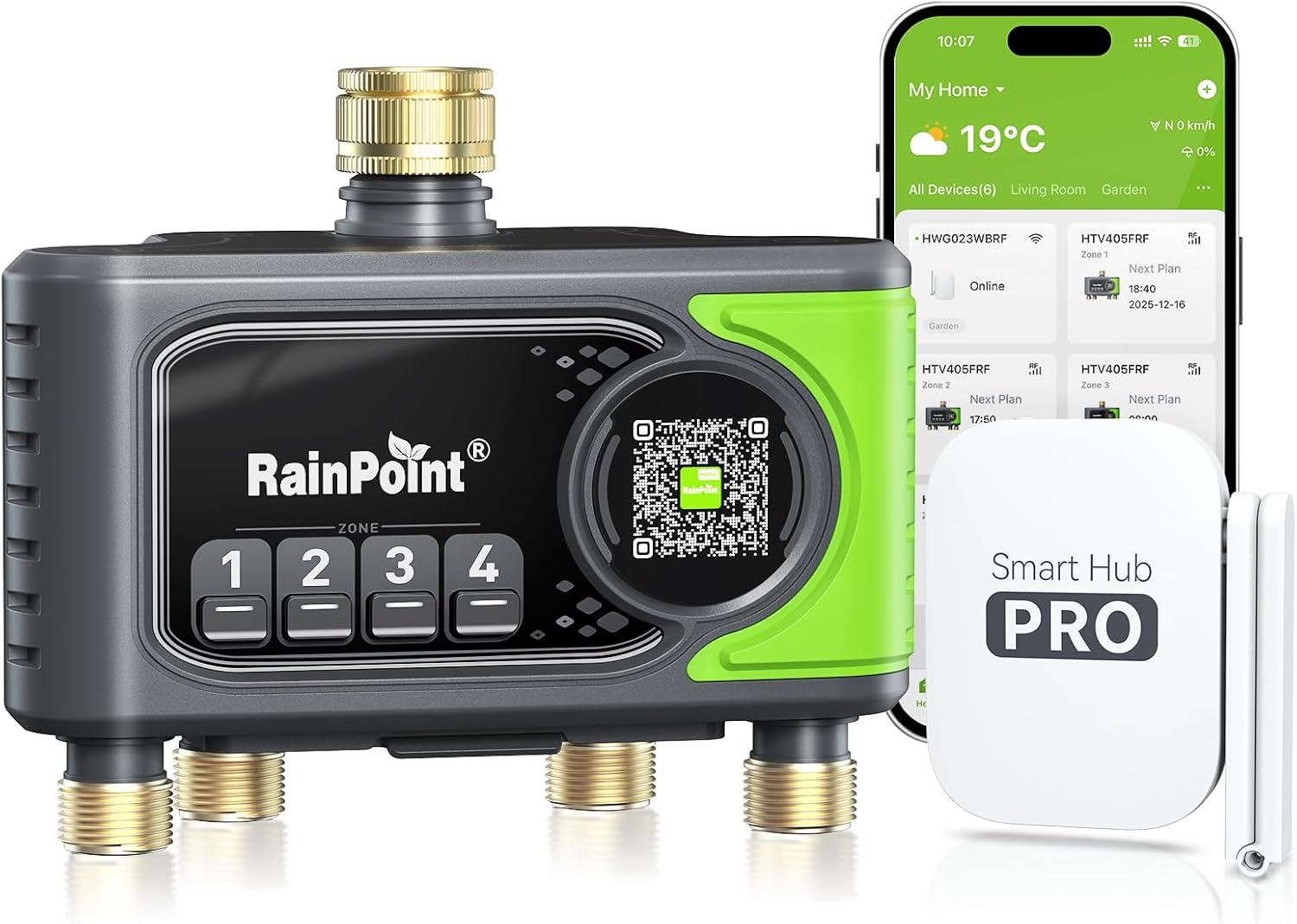 RainPoint
 Two zones over Wi-Fi — set it before you fly, watch it water while you are away.
Why the 2-zone costs more than the 4-zone
The RainPoint 2-zone at AED 449 costs more than the Johgee 4-zone at AED 399 because you are paying for different radios and kit, not fewer zones. The RainPoint kit bundles a Wi-Fi hub and flow-metering valve hardware; the Johgee uses a simpler RF gateway. More zones does not always mean a higher price — the compare page breaks down exactly what is in each box.
Not sure which one your villa needs?
Tell us where your tap is and how far it sits from your router, and we will point you to the right timer before you buy — no pressure. Contact us and, if you can, add a photo of your tap so we can confirm the fit.